


 01422 396 769
  quote
quoteCan you tow with an electric vehicle? In many respects, EVs, being heavy and torquey, are perfect for pulling caravans. John Sootheran gets his research head on!

In 2025, 23% of new cars sold in the UK were EVs. Futuristic designs, silent and powerful motors, and battery capacity improving by the month, it seems that ‘our friends electric’ are here to stay, and getting better and better with each new launch.
Much of my publishing career has been spent worshipping at the shrine of the internal combustion engine (ICE) – the smooth, whisper of a straight-six and the guttural growl of a V8 – but, having driven a few EVs in recent times, I have to say, ‘they are bloody good’. Smooth, powerful and cheap to run (if you can charge at home), they have hundreds of times fewer moving parts than an ICE car, so there’s less to go wrong. But can you seriously consider an electric car to tow a caravan or trailer tent? A tsunami of anti-EV memes on social media, would have you believe not, but let’s look at the facts.

Can an electric vehicle really tow a caravan?
Yes, they can, and they perform very well.
In the 2024 and 2025 Towcar of the Year Awards testing, electric vehicles performed admirably. In 2025, EVs came top in five categories, hybrids, also took five awards, while ICE cars took four.
EV Towcar Award winners
The BMW i5 eDrive40 Touring claimed the 1500-1600kg caravan category, plus the Electric Towcar and Luxury Towcar class wins. Judges praised its performance ‘across the board’.

Volkswagen’s ID.7 Match Pro won the <1200kg caravan class, and was described as ‘super stable’ and ‘very nimble’.

Hyundai’s Ioniq 5 Ultimate won the 1600kg-1700kg category, and was described as ‘‘Lovely – smooth, comfortable and great to drive.’
Do EVs have type approval for towing?
We spoke to Tom Miller, CEO at towbar gurus, Tow-Trust.co.uk:
“My advice is the same for EVs, as it is for ICE (internal combustion engine) vehicles: always check the vehicle’s VIN plate before installing a towbar or using the vehicle for towing. This makes sure, firstly, that the vehicle is type-approved for towing, and secondly, that its towing capacity is suitable for your intended use.”
As some EVs have zero towing limit, you should always follow Tom’s advice.
VIN Plates
Your towcar’s VIN plate is usually found under the bonnet or on a front door jamb. It will be either a riveted alloy plate or a sticker. Typically, it features three or four lines showing weights in kgs – these are:
2190kg – Gross vehicle weight, the Maximum Allowable Mass (MAM) of the vehicle including occupants, fuel and payload.
4050kg – Gross train weight, the Combined Maximum Allowable Mass of the vehicle and trailer.
1045kg & 1175kg – Maximum front and rear axle loads.
The manufacturer’s recommended maximum towing capacity for your vehicle is the gross vehicle weight subtracted from gross train weight.
In this case, 4050kg – 2190kg = 1860kg.

So this vehicle has a maximum braked trailer weight of 1860kg. This assumes the manufacturer hasn’t set a lower limit in the handbook (many do). Noseweight limits are separate and not shown on the VIN plate.
If the gross train weight figure is missing, the car is NOT type approved for towing.
How big a caravan can I tow with my EV?
Probably not as big as you think. Although EVs are very heavy, it’s not a good idea to simply apply the 85% rule, and head out with a two-tonne tourer. Check your manual or the manufacturer’s website to see what towing weight limit is recommended, and stay within that allowance.
Can all EVs have tow bars fitted?
Tom again: “We design, test and manufacture a wide range of towbars for electric vehicles that are approved to tow. In practice, we see EVs as no different from ICE vehicles – they offer strong towing capacities and sufficient battery performance for towing applications.”
If your EV is type-approved for towing, there’s a decent chance Tow-Trust will do a towbar for it.
What about weight matching with EVs?
This is where we’d take extra care, as the standard 85% towing rule may not apply.
EVs are typically heavier than the equivalent ICE car, but that doesn’t mean they can tow a heavier caravan. Check your manual for specific towing-limit information.
Likewise, remember to factor in your EV’s noseweight limits to guarantee a stable towing experience.
Does towing affect EV driving range?
Towing a caravan will lower your EV’s range potential – experts say by 40-60%. That means longer tours may need a charging stop, or even two.
Planning ahead is recommended, so that you can coordinate your charging stops with driving breaks, coffee stops, lunch and doggie comfort breaks.
Remember – to charge, you may need to unhitch to fit into the bay. If you leave your caravan unattended or out of sight in service stations, always fit and activate security devices you have listed on your caravan insurance policy. Theft of caravans from service stations is not unheard of.
We’d estimate that a good-quality towing fully charged EV, with a 300-mile standard range, should cover 150-200 miles without further charge when towing which is probably enough for most caravan trips.
Can I charge using a campsite pitch hookup?
The short answer is usually no – or at least, not properly, and not without permission. Most UK campsite electric hook-ups (EHU) are not designed for charging electric cars, they do not have the load capacity. If several campers try to charge EVs at the same time, the site’s electrical infrastructure would overload.
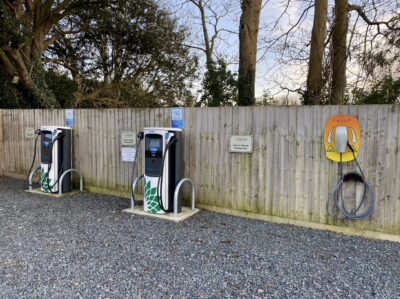
Hook-ups are powered assuming caravan-level loads, not the sustained high-draw needed by an EV, which can overheat cables and sockets. Also, the excessive use of electricity isn’t factored into campsite EHU charging.
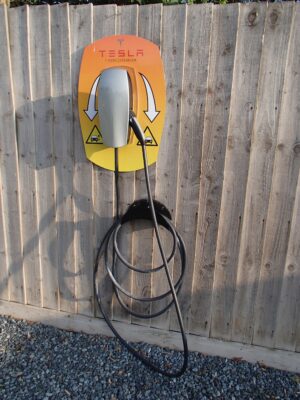
If you get ‘caught short ‘(of power), always ask the campsite’s advice and permission before trying to charge. Many caravan sites now offer specific EV charging points.
Is it easy to charge an EV while towing?
It’s not as quick as popping £50 of diesel in your Passat, but it’s fairly straightforward.
Using charging stations enroute can cost up to 10 times more than charging at home, so aim to leave home with a full battery. Towing at 55-60mph will use much less charge than speeding at 65mph or higher.
Plan your stops beforehand using an app like the excellent Zapmap, which helps you find and pay for your electricity. Zapmap can also tell you if all the chargers at your planned stop are working.
Many public charging bays will require you to unhitch your tourer before you can charge.
How long does it take to charge?
Charge time will depend on your vehicle, its age, and the charge-point output. Superfast charging can take you from 20% to 80% charge in as little as 25 minutes with the most modern EVs. However, we’d allow about 50 minutes to add 100 miles of charge at a typical 100kW charge point.
Do I need to tell my EV car insurer I’m towing a caravan?
It’s not a legal issue, but we’d advise you to let your EV car insurer know that you plan to tow a caravan.
What about towing in Europe with an EV?
You’re good to go, as UK and European EV-charging sockets are largely compatible. Both regions predominantly use the Type 2 connector (Mennekes) for AC charging, and CCS2 (Combined Charging System) for rapid DC charging.
You can drive a UK-registered EV into Europe and charge without needing special adapters. Hurrah!
EV Myths Investigated
EV range is too limited
Facts: Most modern EVs offer 200 to 350 miles of real-world range. This covers the vast majority of daily driving needs. However, towing will lower this to approximately 125 to 225 miles. Long journeys need planning, but are increasingly viable with the UK’s expanding rapid-charging networks.
Charging takes too long
Facts: Home charging overnight easily covers daily use. Rapid chargers at service stations can add 100 to 200 miles in 20 to 30 minutes.
Battery production is worse for the environment
Facts: Battery production is energy-intensive, but lifecycle studies show EVs generally produce significantly lower total emissions over their lifespan, especially as electricity grids decarbonise.
Batteries degrade quickly and need replacing
Facts: The latest research reveals that modern EV batteries will last for many years. Real-world data shows modest degradation, often around 10 to 20% over eight to 10 years. Most manufacturers offer long battery warranties, and an increasing number of organisations (AVILOO, ClearWatt) offer ‘Battery Life Checks’ for buyers of second-hand EVs.
There isn’t enough charging infrastructure
Facts: The UK has more than 35,000 public charging sites (with 70,000+ chargers). There are 8,400 petrol stations across the country. That said, some rural areas are still poorly served in terms of EV charge-points, so journey planning is necessary.
EV charging is only cost-effective if you have a driveway
Facts: There’s an element of truth to this. Charging at home can be very cheap, with the likes of Octopus Energy offering nighttime smart-charging from as little as 7.5p/kWh. Meanwhile, if you have to rely on expensive public chargers, that cost can be 54p to 80p per kWh. Organisations like Kerbocharge offer solutions that allow on-street charging from home-charger units at the lower price.
EVs are a fire hazard
Facts: Statistically, EVs are much less likely to catch fire than ICE cars.
Greater London Authority figures in 2023 revealed the following stats for car fires: Petrol cars – 493; diesel cars – 138; battery electric cars – 7.
EVs are too expensive
Facts: Upfront costs can be higher, but lower fuel and maintenance costs often reduce total cost of ownership over time, especially for high-mileage drivers.
Second-hand EV prices have plummeted in the last year, so you could pick up a warrantied, three-year old EV, with a battery at around 95% of its original charge capacity for less than half its new-cost.
Electric grids can’t cope with EV adoption
Facts: Managed charging, smart tariffs and grid upgrades are already being implemented. Studies suggest that grids can adapt with planned investment and demand management. In some ways, this is an incentive to adopt electric motoring sooner rather than later!
Summary
Choose the right EV and you can tow quite happily – perhaps just with a plan to charge up when you stop for coffee or lunch en route. Use the web and Google Street View to assess the charging station. EV’s are fast and stable tow cars, and if you can charge at home, you could save a few bob, too. Just make sure to plan your journeys properly and that you can charge at or near your destination.

The technology’s coming on in leaps and bounds too, so things will only get better. Watts not to like?!
The NCC (National Caravan Council) has also published a consumer guide that highlights why electric vehicles (EVs) make good tow cars. Its Electric Vehicle Towing guide can be downloaded here.
Which electric vehicles can tow?
Here is a list of vehicles approved for towing:
| Car Make / Model | Max. Towing Capacity (Braked, 12% gradient) |
|---|---|
| Audi Q4 e-tron (inc. Sportback) | 1000-1200kg* |
| Audi Q6 e-tron | 2000-2400kg |
| Audi Q8 e-tron quattro (inc. Sportback) | 1800kg |
| BMW i4 | 1600kg |
| BMW i5 | 1500-2000kg* |
| BMW i7 | 2000kg |
| BMW iX | 2500kg |
| BMW iX1 | 750-1200kg* |
| BMW iX2 | 750-1200kg* |
| BMW iX3 | 750kg |
| Citroën ë-Berlingo M | 750kg |
| Citroën ë-C3 | 550kg |
| Citroën ë-Spacetourer | 1000kg |
| Ford Explorer | 1,000-200kg |
| Ford Mustang Mach-E | 750-1500kg |
| Genesis Electrified GV70 | 1800kg |
| Genesis GV60 | 1600kg |
| Hyundai Ioniq 5 | 750-1600kg** |
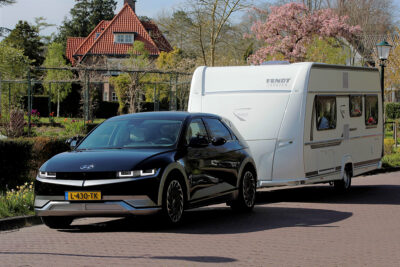
| Hyundai Ioniq 6 | 1500kg |
| Hyundai Kona EV | 750kg** |
| Jaguar I-Pace | 750kg |
| KGM Torres EVX | 1500kg |
| Kia EV6 | 1600kg |
| Kia EV9 | 900-2500kg* |
| Kia Niro EV | 750kg |
| Lexus RZ 450e | 750kg |
| Lotus Eletre | 2250kg |
| Maserati Grecale Folgore | 1800kg |
| Maxus MIFA 9 | 1000kg |
| Mercedes-Benz EQA | 1500-1800kg* |
| Mercedes-Benz EQB | 1400-1700kg* |
| Mercedes-Benz EQC | 1800kg |
| Mercedes-Benz EQE | 750-1700kg* |
| Mercedes-Benz EQE SUV | 1800kg |
| Mercedes-Benz EQS | 750kg |
| Mercedes-Benz EQS SUV | 1800kg |
| MG ZS | 500kg |
| MG4 EV | 500kg |
| MG5 EV | 500kg |
| Mini Aceman | 750kg |
| Mini Countryman | 2000kg |
| Nissan Ariya | 1500kg |
| Peugeot e-3008 | 1250kg |
| Peugeot e-Rifter | 750kg |
| Peugeot e-Traveller | 1000kg |
| Polestar 2 | 1500kg |
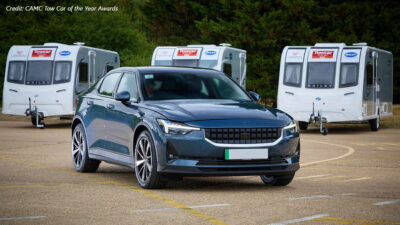
| Polestar 3 | 2200kg |
| Polestar 4 | 1500-2000kg* |
| Porsche Macan | 2000kg |
| Renault 5 E-Tech | 500kg |
| Renault Mégane E-Tech | 900kg |
| Renault Scenic E-Tech | 1100kg |
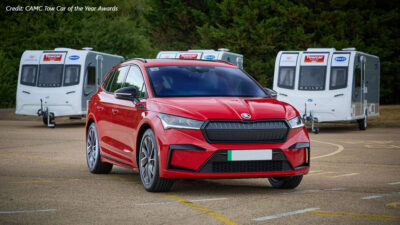
| Skoda Enyaq iV (inc. Coupe) | 1200-1400kg* |
| Smart #1 | 1600kg |
| Smart #3 | 1600kg |
| Ssangyong Korando EV | 1500kg |
| Subaru Volterra | 750kg |
| Tesla Model 3 | 1000kg |
| Tesla Model X | 2268kg |
| Tesla Model Y | 1600kg |
| Toyota BZ4x | 750kg |
| Vauxhall Combo-e Life | 750kg |
| Vauxhall Vivaro-e Life | 1000kg |
| Volkswagen ID.4 | 1000-1200kg* |
| Volkswagen ID.5 | 1200kg |
| Volkswagen ID.7 | 1200kg |
| Volkswagen ID.Buzz | 1000kg |
| Volvo EC40 | 1500-1800kg* |
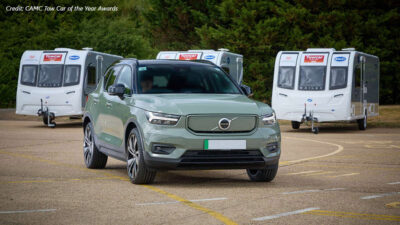
| Volvo EX30 | 1000-1600kg* |
| Volvo EX40 | 1500-1800kg* |
| Volvo EX90 | 1200-2200kg* |
** Long-range battery only
This list may not be exhaustive.
Correct at time of publication - March 2026.
Always check vehicle suitability before buying/towing


 Tourer, trailer tent or folding camper claims
 Motorhome, RV or campervan claims
 Static caravan claims
 Park home claims
Agree with Steve. EV’s are obviously excellent technically and, provided you can afford them (not included in the review) they make good tow vehicles provided you tow ‘on grid’. What happens to those of us who like to explore and use CL’s. No CL which I use would accept the 12amp. minimum charging current, and other charging locations do not exist.
I will stay with my diesel as long as possible and then go to Hydrogen, if and when Toyota gets their engine working. We will then have the problem of where to get it!!
The EV’s that can cover a reasonable distance are way out of my price range, and I expect the majority of readers. Will stick with my tried and trusted diesel.
Leave Gulf of St. Tropez at 7am, arrive at Dover 23 hours later, home on the Isle of Wight by 4pm with Honda CRV and Coachman Pastiche.
Try doing that with an EV!!
I get the fact you’re pleased with towing with your ev. But with the greatest respect, traveling to a known site regularly is hardly towing around the country, or abroad. It works for you, but you’re limiting your site choice and journey. Hardly representative of how touring caravans are used!
I have towed for 2 years with an EV, currently a Kia EV6, I plan ahead, there are now so many chargers compared to when we started with an EV that I have found charging becoming easier and quicker, can manage about 150 miles, just over 50% of range without caravan. Wonderful to drive and tow, pulling away is effort less and never stalls. Current caravan,4 berth, loaded1500kg, car max 1600kg. We never do more that 2hrs driving before a break, in my 80’s so that may be an age thing, and we love Winchester Instavolt charging hub where they have long bays so no unhitching. The only annoying thing is that, with the now super fast chargers, the car is charged before had the necessary comfort break, for us plus the dog, and the coffee.
Plenty of info. too optimistic at present unless a very small caravan.
I think this article over simplifies towing with an ev. The range is lowered by at least 50%, worse in windy ,wet conditions. So, knowing you have to have some capacity left in the battery when you get to a charger this affects usable range even more! I get less than 100 miles before needing a top up. Less than 11/2 hours driving. Unhitching and locking your van shouldn’t be played down. It’s a pain! Then if the charging bays are full you have to wait for a space. This can add significantly to the stop you make every 11/2 hours. So your article glosses over how painful towing is with an ev. Not to mention the weight restrictions, needing a smaller lighter van.