


 01422 396 769
  quote
quoteWant to keep things cool in your caravan, campervan or motorhome as the outside weather gets hotter? Better air quality and ventilation in your vehicle?
Air conditioning to your main living quarters is the answer. It’s not cheap, but there’s good news in that air-con units are getting ever more efficient – even so, they’re never going to be the cheapest addition to your leisure vehicle
But, as the weather gets ever warmer, any opportunity for some cool relief has to be welcome. Here’s our guide to the world of air conditioning for caravans and motorhomes.
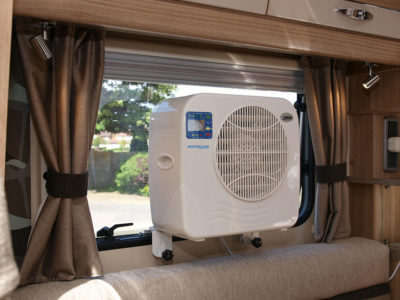
Top caravan and motorhome air conditioning tips
- Your leisure vehicle’s overall length is an instant indicator of how powerful an air conditioning unit you’re going to need.
- Make sure it fits. This is particularly pertinent for roof-mounted models. As well as finding a rooftop location where space may be at a premium, you might want to check with your supplying dealer and/or the original manufacturer whether your leisure vehicle’s roof is strong enough to support an air conditioning unit.
- Check for refrigerant type – this is the specialist fluid used in the cooling process and its ‘R value’ is a guide to how it performs as well as its environmental impact.
- Air conditioners with integrated heat pumps mean they can also provide warm air when needed.
- As with the fitting of any aftermarket products, do calculate the effect it’s going to have on your payload margin. A typical air conditioning unit will weigh in excess of 20kg.
- If you have a particularly large motorhome or touring caravan, you might even need to consider more than one unit – or sectioning off a single area you want to cover (e.g. a bedroom).
- Other considerations include how much electrical current an air-con unit is likely to draw, any space it’s likely to take up, and whether you want to switch it over to your next caravan or motorhome etc.
Insurance considerations
If you’re having an air conditioning unit fixed to your caravan or motorhome, don’t forget to include it your motorhome or caravan insurance sums insured, so it’s covered in case it gets damaged or stolen.
Also see our video with tips for keeping cool in your caravan or motorhome.
Star Player #1
Dometic FJZ7 2600
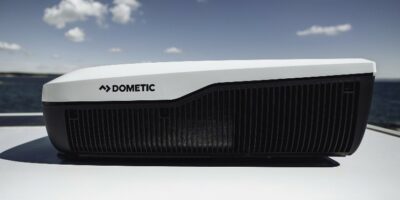
In time for the 2026 season, Dometic announced the next generation of its air conditioners for leisure vehicles. There are two ranges – premium FJZ27 and entry-level FJZ4 – each promising improved performance, quieter operation and reduced energy consumption over previous models.
The FJ27 2600 here is available in black or white and, like other FJ27 models, includes patent-pending adaptive power mode, which includes low-fuse protection – it means you’re unlikely to trip out your mains hook-up supply as it automatically adapts to the capacity available. You can also use the Dometic Power App to control the unit from anywhere.
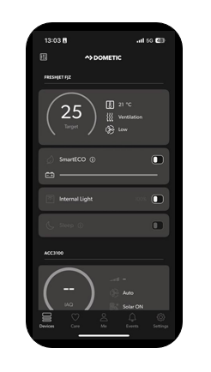
Also here is SmartECO that, in conjunction with the Tempra battery, optimises battery power consumption and switches automatically between energy-saving to fan modes to complete shutdown, restoring power when the charge level reaches 60%.
Plus, it has patented purifiers that remove dust, damp, and bacteria, meaning no chance for mould to develop and no unwanted smells.
Dimensions for the FJ27 2600 are 75.2cm deep x 22.5cm high x 70.2cm wide, and it will slot in easily to replace a typical 40cm x 40cm rooflight.
Key features Inverter compressor and heat pump technology, digital controls with Wi-Fi connectivity, Advanced Soft Start, heating and cooling functionality, 2,600Watt cooling capacity, 43dB sound level, net weight 31.1kg, R32 refrigerant type (for efficiency and reduced environmental impact; mildly flammable)
Expect to pay £2,715
Star Player #2
Truma Aventa Comfort
Latest Aventa Comforts are the second generation of this ever-popular German-made, lightweight, roof-mounted air conditioning unit. Truma says it’s suitable for leisure vehicles over 7m long, with others in its portfolio designed for smaller units. Powered by mains electricity, its built-in heat pump means it can also provide warm air when needed.
As with all Truma air conditioners, if you already have a Truma Combi heater, you can use the automatic climate control function working across both systems to maintain constant on-board comfort.
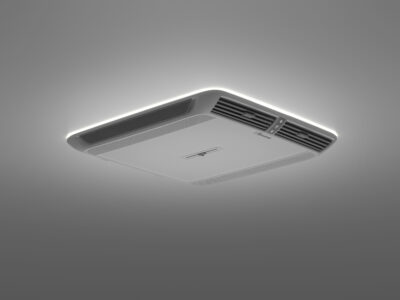
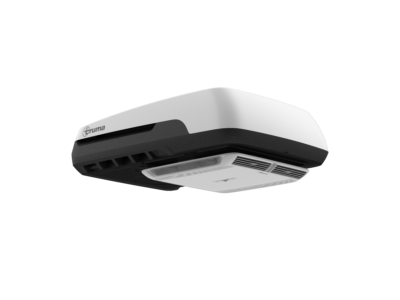
Operation is easy using a Bluetooth remote control and/or via an iNet X panel, the iNet X app or CP Plus. Features also include thoughtful touches like night mode that keeps noise levels right down when needed.
Overall external dimensions 100.8cm long x 66.5cm wide x 24.3cm high and it’s available in black or white.
Key features 2,500Watt/2,000Watt cooling/heating power, 4.2amp power consumption, total weight 28.7kg, five-year warranty when fitted by a Truma agent
Expect to pay £1,825
Star Player #3
Teleco Ultra Comfort 6000
Marketed as an ideal solution for van conversions, campervans and coachbuilt motorhomes based on Fiat’s Ducato (and its Peugeot Boxer and Citroen Relay equivalents) up to 8m long.
This mains-powered system comprises two parts – an internal outlet (diffuser) with vertical and horizontal adjustable grids that fits onto the dashboard and two units featuring the mechanical aspects that fit behind the front bumper. You also get a remote control and Wi-Fi connectivity.
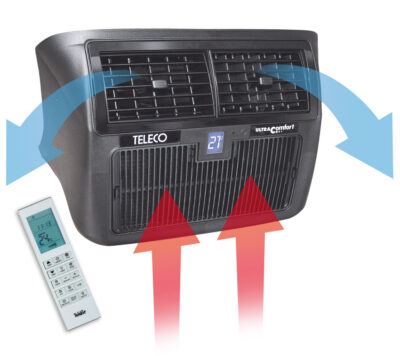
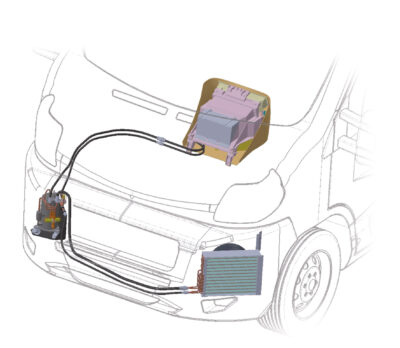
Advantages of a unit like this is you don’t lose a rooflight as part of the fitting, it’s not visible externally, and it can be fitted to vehicles with elevating roofs.
There’s also a more powerful sister model, the 8000.
Key features Cooling and heating function, three fan speeds plus auto, weight 28kg, refrigerant type R134a, 2.9amp current absorption, 1.76kW/1.67kW cooling/heating capacity, LCD display
Expect to pay £2,877
Star Player #4
Isabella Isacool
A mains-powered, roof-mounted unit that can cool as well as heat, with Isabella saying it can operate between temperatures of -5degC and +50degC. Its design is for any leisure vehicle roof with a thickness between 23mm and 25mm. It can be slotted into the 40cm x 40cm aperture of a typical rooflight.
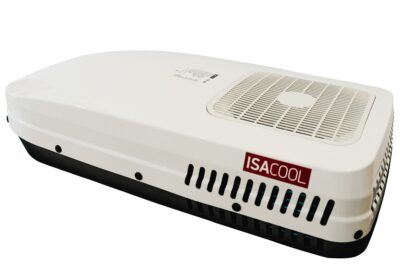
Maximum power draw is 4.1amps for cooling and 3.7amps for heating.
The HeroCamper app allows you to control temperatures, set the timer and switch between cooling and heating.
Key features 2,400Watt cooling/heating powers, weight 33kg, R32 refrigerant, external dimensions 24.4cm high x 107.9 cm long x 56.7cm wide.
Expect to pay £1,499
Star Player #5
Quest Ice Chill
A mains operated portable air condition unit that can be used straight out of the box for cooling as well as heating. The Quest Ice Chill also has a split configuration – i.e. units for use indoors or out. Also, if you put the compressor unit outside your vehicle (or in the awning) noise levels in the main living quarters are noticeably reduced. Performance is also enhanced this way, as warm exhaust gases are dissipated outside rather than inside your vehicle.
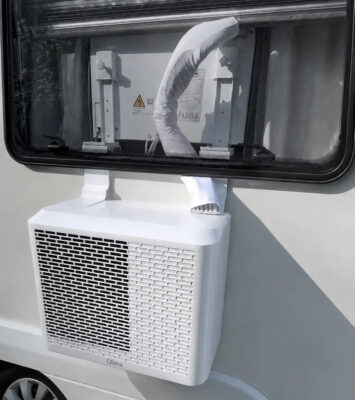
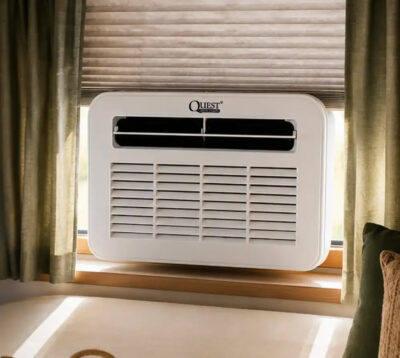
Quest says the Ice Chill has an A-rated Energy Efficiency Ratio (EER) of 2.6 and a Coefficient of Performance (COP) of 2.6, rated A+ for heating.
Operation is via its LED display panel, remote control or Wi-Fi app. Also, its R290 refrigerant is a natural hydrocarbon with a low GWP (Global Warning Potential).
Key features 24-hour programming, adjustable fan speed with auto-swing function, 25.4kg total weight, 12-month warranty
Expect to pay £842
Star Player #6
Truma Saphir Compact
The main unit of the Saphir Compact typically stows at floor level (in a seat base being the most obvious location), making it particularly well suited to small- to medium-sized motorhomes and caravans.
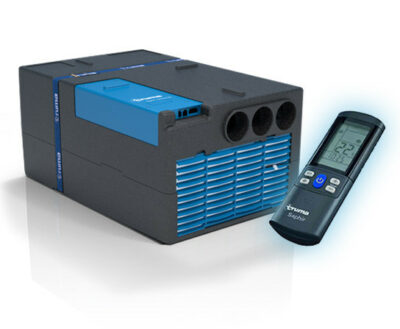
Its 1800Watt cooling power also dehumidifies and cleans the air. Truma points out this unit can be used on most campsite mains hook-ups (3amps minimum). It also comes with a five-year warranty when fitted by an authorised Truma agent.
It’s also relatively light, coming in at exactly 20kg (unit only). Dimensions are 56cm long x 40cm wide x 29cm high. It can also be used via Truma’s CP Plus iNet-ready panel and synchronised with your Truma heating if already fitted in your vehicle.
Key features Three fan speeds and two operating modes (cooling and air circulation), remote control, programmable up to 15 hours in advance, fluff and particle filters included
Expect to pay £1,500 (including ducting kit)
An air-con alternative…?
Star Player #7
Quest Bolivia 4L Evaporative Cooler
This may not be quite as complete as full air-con, it’s certainly an alternative worth considering – especially as it costs considerably less and is more energy-efficient.
It’s an evaporation cooler, which means it uses water evaporation to lower the ambient temperature by pulling warm air through a system of water-soaked pads. It also dehumidifies.
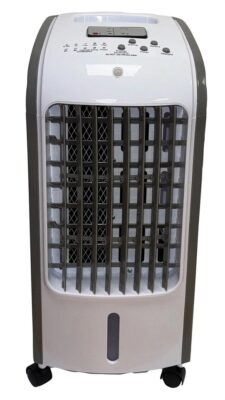
Dimensions are 26cm x 24cm x 57cm high and it comes on castor wheels for easy manoeuvring.
A final bonus – it weighs just 3.8kg before it’s filled with water.
Key features 80Watt cooling power, remote control, three fan speeds, four-litre water tank, timer (0-7.5 hours), automatic horizontal swing control, manual vertical airflow adjustment, level indicator for water tank
Expect to pay £84
Or you could just fit a fan…
Star Player #8
Fiamma Turbo Kit Fan
OK, so it’s not full air conditioning, but this clever bit of kit slots into an existing rooflight. Check for full details, but it typically fits any rooflights from 40cm x 40cm to 50cm x 70cm apertures.
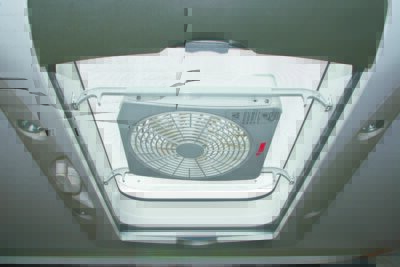
The fan itself has a 24cm diameter and can act as an extractor or to bring in fresh air. It fits via two telescopic hangers that adjust between 36cm and 48cm. It can be hardwired or run via a cable to a 12V socket and can also be run via batteries (8 x 1.5VD).
Key features Reversible and variable speed fan, supplied with 12V DC cable, two speed settings, weight 1.3kg
Expect to pay £100
How a typical air conditioner works in a caravan or motorhome
Caption: Image courtesy of Truma.
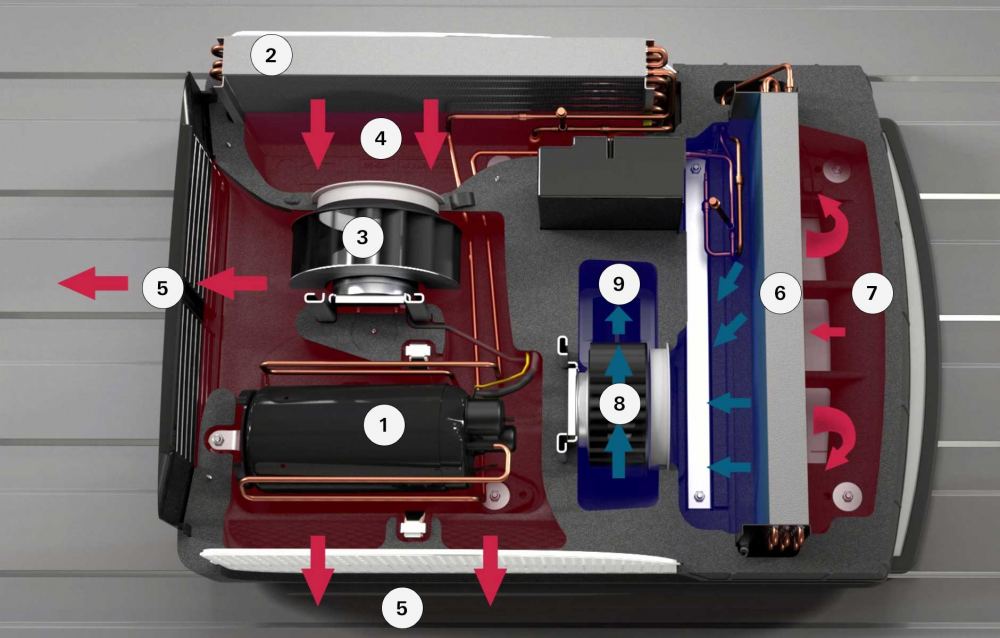
A gaseous refrigerant circulates around a closed cooling circuit. This is drawn in and compressed by a compressor (1). The high pressure causes the temperature of the refrigerant to greatly increase. The hot refrigerant is pumped into the condenser (2). Here it is cooled down by means of a fan (3) that blows outdoor air (4) over the fine structures of the condenser.
In this process, the refrigerant gives up its heat to the ambient air and its temperature falls, causing it to change from a gas to a liquid. The heated ambient air escapes again (5). The refrigerant, now in liquid form, is conveyed into an evaporator (6). Here it is vaporised by means of warm air from the room (7), which is drawn in and blown over the evaporator by a fan (8).
During this process, the refrigerant absorbs the thermal energy from the surroundings, causing the temperature in the room to decrease. At the same time, the evaporator fan (8) conveys the cool air to the interior of the caravan or motor home (9).
During the evaporation process, the refrigerant changes again from a liquid back to a gas, before flowing back to the compressor (1) to start the cycle again.
Credit: Truma
Over to you…
Got any advice on habitation air conditioning for caravans and motorhomes to pass on to other owners? Feel free to add your comments below.


 Tourer, trailer tent or folding camper claims
 Motorhome, RV or campervan claims
 Static caravan claims
 Park home claims
Having truma comfort plus gen 2 fitted next month as travelling got in france spain Italy etc with a dog and will need it as last few years been uncomfortable
Most of these units are not suitable for a caravan owing to their weight – most are 27kg or greater. This will have to come off your caravan payload and will severely limit what you can carry in your caravan.
How about for VW style converted campervans? all these seem t o be too big for a van conversion, and the one with water pads effect will be limited in humid conditions..
We had it fitted to our new Knaus Sudwind, we went for the Truma model as above. Got to be honest, in the heatwave in France and Spain over the last couple of weeks it was a game changer! It means you can sleep (and the dog!) you do have to get used to the noise, they say it’s ’whisper quiet’ maybe if you compare it to a v8 but we’d never go back!!
We’re seriously looking at getting aircon fitted to our motorhome once we return to the UK. This is a very helpful article. Thanks